
The after-hours calls and cold quotes that slip away — and the reports, the re-keying, the spreadsheets eating your team's week. I set up systems that handle it: sometimes a tool you already have, sometimes something I build. Depends what's actually wrong.
The assessment is a paid, standalone deliverable — you keep the plan either way. The call is just to see if we're a fit, no strings.
of software features are rarely or never used — you're likely paying for tools you never switched on.
of the work week is lost to manual, repetitive tasks that software could be doing.
to find out where you're leaking — start with a paid assessment and keep the plan no matter what.
Some of it slips through the cracks the moment nobody's at the desk. Some of it just quietly eats your team's hours. Both are fixable — and I'll always tell you whether the fix is a tool you buy or something worth building.
After-hours and mid-job calls that never get a callback — answered, qualified, and booked into the calendar you already use.
The estimate goes out, nobody follows up, it quietly dies — now it gets followed up on its own until there's a yes or a no.
The review request that only happens when someone remembers — sent automatically after every completed job.
Intake forms, PDFs, permits, contracts — re-keyed by whoever has a free hour. Read and filed into your system for you.
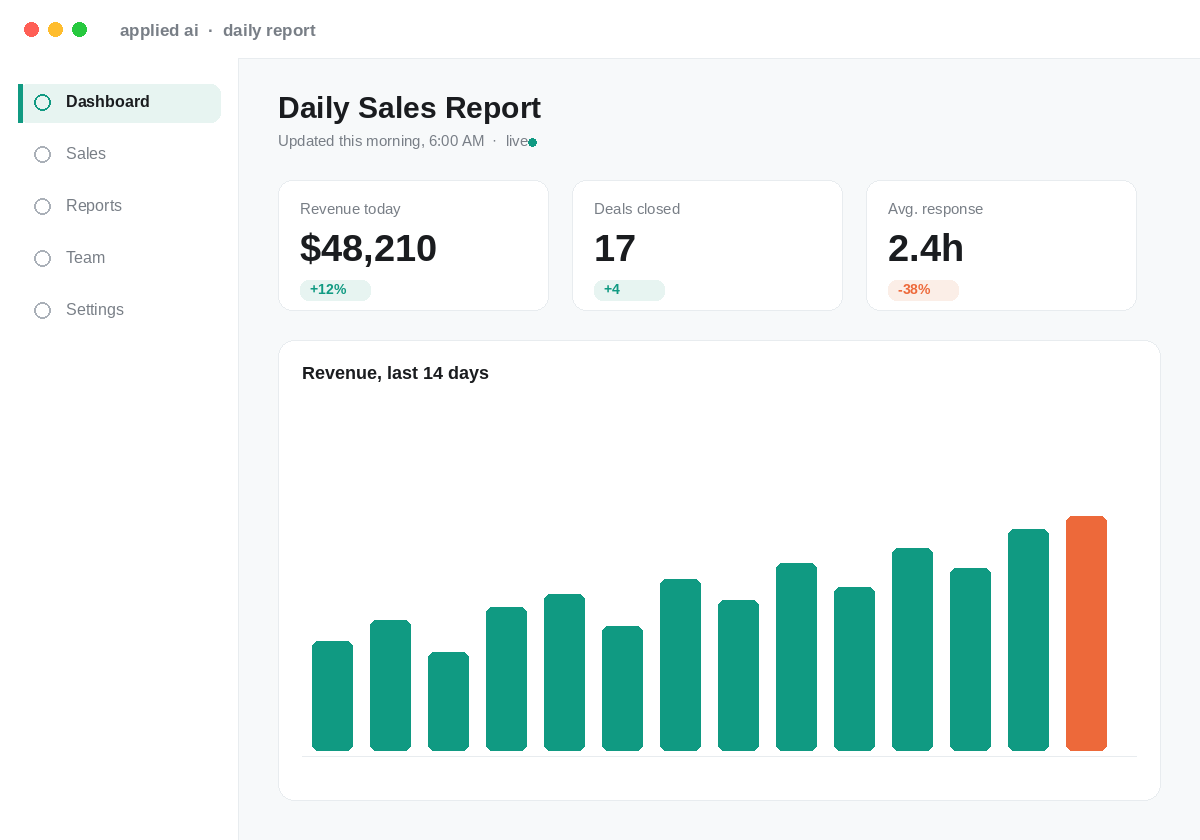
The report someone rebuilds every week, or the numbers nobody has time to assemble — delivered on their own, where you actually look.
The spreadsheet three people maintain, or two systems that don't talk — replaced, or wired together, so the busywork disappears.
Recommending the tool you should go buy is what makes me worth trusting with the thing you should build. Being honest about which is which isn't a missed sale — it's the whole pitch.
Often the tool already exists — sometimes you already pay for it and never turned it on. I point you at it and set it up. No markup, no games.
Switch on what you own, connect the tools that don't talk, and put a smart layer on top. The plumbing between your systems is where the hours hide.
When it has to fit your scheduling, your job types, your pricing rules — I build it. That's the half nobody can hand you off the shelf.
I walk through how your business actually runs and hand you a written plan: what to switch on, what to build, and what the leaks are costing you now. It stands on its own — you keep it either way.
Fixed scope, fixed price, in writing before anything starts. Some fixes are live in days; a custom build is typically three to four weeks.
A flat monthly for monitoring, tuning, and changes — and someone who notices when it drifts. You're paying for the wiring into your business, not for the AI.
The tools aren't the moat — anyone can rent those. What's yours is the wiring into your business, and the fact that when it drifts, someone notices. You own the code, you know where it runs, and if you ever want to move it in-house, I hand you the keys. Small businesses have been burned by vendors they couldn't leave. Being leaveable is the point.
For the fixes that have to be built, you get 38 years of engineering pointed at one problem: fixed price, three to four weeks, and code that's yours. No handoffs, no offshore team, no surprise invoice.
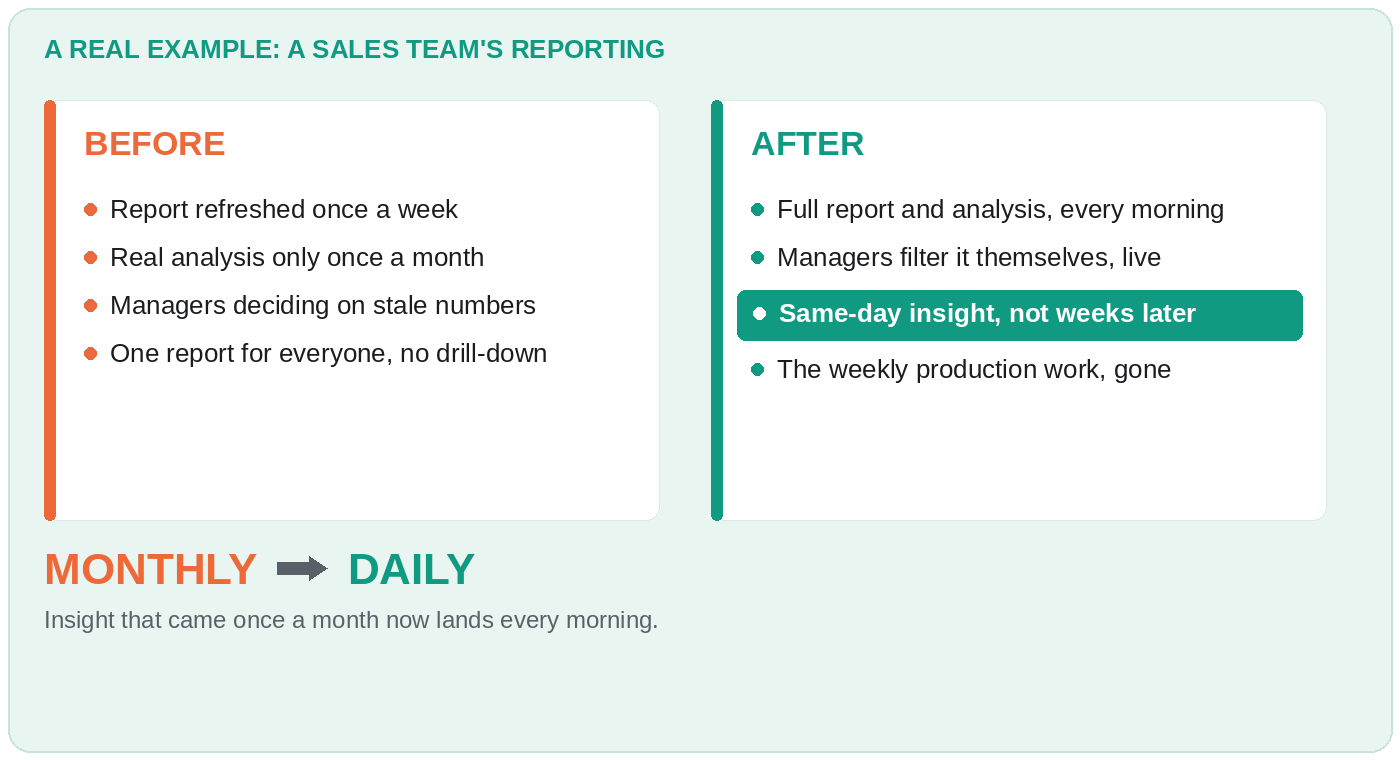
A real one: a sales team was making this month's decisions on last month's numbers. I replaced their weekly report and monthly analysis with a system that rebuilds itself every morning — filterable by each manager, live.
The enterprise practice hasn't gone anywhere. Data platforms, systems architecture, revenue systems, AI strategy — the kind of work that runs longer and involves more people. If that's what you need, it's very much on the table.

I began in 1988 doing exactly this: solving unglamorous, expensive problems for small businesses. Back then it took months and cost a fortune, so the industry drifted upmarket and left smaller companies behind.
The tools finally caught up. AI didn't replace experienced engineers — it made this work fast and affordable enough to be worth it again for a business your size. I've built in about as strict an environment as software gets — a healthcare document pipeline handling sensitive records. If it holds up there, it'll hold up in your shop.
Rod Castor · Applied AI · Edmond, Oklahoma
Start with a paid assessment, or a free call first if you'd rather. Worst case, I tell you honestly that you're fine as you are.